Why knowing what to do can feel so different from doing it
Why am I afraid to place a trade when I can see what’s happening?
Have you ever looked at a chart and thought, “I know what’s happening here. I can see it,” and yet when it came to placing the trade, you simply couldn’t do it?
Perhaps you’ve traded for years. You’ve read the books, watched the videos and learned the indicators. Looking back over a chart, you can explain exactly what happened. But when your own money is involved, something changes. You hesitate. You look for one more confirmation. The market moves, and you’re left wondering why you couldn’t do what seemed so obvious.
I recently heard from a trader who put this rather well. After so many bad experiences, he said, he could see how the market was behaving but couldn’t even begin trading again. He wanted to know how to stop seeing trading as a threatening place. I think that’s a much bigger subject than most people realise.
Understanding a market and risking money in it are not the same thing
The first step is to recognise that understanding a market and being able to comfortably put money at risk in it are two different things. You can have a very good understanding of what you’re looking at and still be frightened of what might happen when you act.
That doesn’t automatically mean you need another indicator or another strategy. It may mean that the experience of trading has become associated with some very unpleasant outcomes.
If that sounds familiar, read on without feeling you have to do anything at the end. I’m certainly not trying to persuade you to place a trade today.
Why do successful professionals find trading so frustrating?
Something I’ve noticed over many years is that some of the people who find trading most frustrating are very capable in other areas of their lives: business owners, doctors, engineers, managers. These are people who have spent decades making decisions and solving problems.
They succeeded in those roles because they learned that when something isn’t working, you can investigate it, put more effort in and change what you’re doing, and quite often things improve. Then they come to trading, bring exactly the same work ethic, and discover that the market doesn’t respond to them. That can be quite a shock.
You can influence a business. You cannot control a market.
Think about running a business. If your sales start falling apart, you can change your pricing, talk to customers, reduce costs or try a different approach. You may not be able to guarantee the outcome, but you can influence it.
Now think about placing a trade. You decide when to enter, how much to risk, where to put your stop and when to get out. But you cannot make buyers come into the market, and you cannot persuade sellers to go away. You cannot work an extra three hours and make the price move in your favour.
That’s a very uncomfortable difference. You are responsible for the decision, but you don’t control what the market does after you’ve made it. I think that conflict sits behind a great many trading problems.
Can a good trading decision lose money?
Yes, and it’s something we have to get comfortable with. A perfectly reasonable trading decision can result in a loss, and a very poor decision can sometimes make money.
That’s difficult, because in everyday life we tend to judge our decisions by what happened afterwards. If we do that with every individual trade, we can learn entirely the wrong lesson. A loss doesn’t automatically mean you read the market badly, and a profit doesn’t automatically mean you read it well.
What matters is:
- why you made the decision;
- what information you had at the time;
- whether you managed the risk you had agreed to take.
Why do I hesitate? How repeated bad experiences change the next decision
Now imagine going through that over and over again. You see something and enter. The market turns against you. Perhaps you move your stop. Perhaps you get out, and then watch the market go exactly where you expected it to go.
Do that often enough and the next opportunity may no longer feel like an opportunity. It can feel like the beginning of another unpleasant experience.
Not everyone responds in the same way. But I’ve seen traders who can explain the market very clearly when there’s no money involved, then struggle terribly when they have to make a decision for themselves. The knowledge may still be there. It’s their relationship with the decision that has changed.
Will another indicator give me the certainty I’m looking for?
So what do we do? Very often we search for more certainty: another indicator, another setting, another confirmation. Something that will finally tell us, “Yes, this is the one.”
Studying the market can be valuable. But there’s a difference between gathering useful information and trying to remove uncertainty altogether.
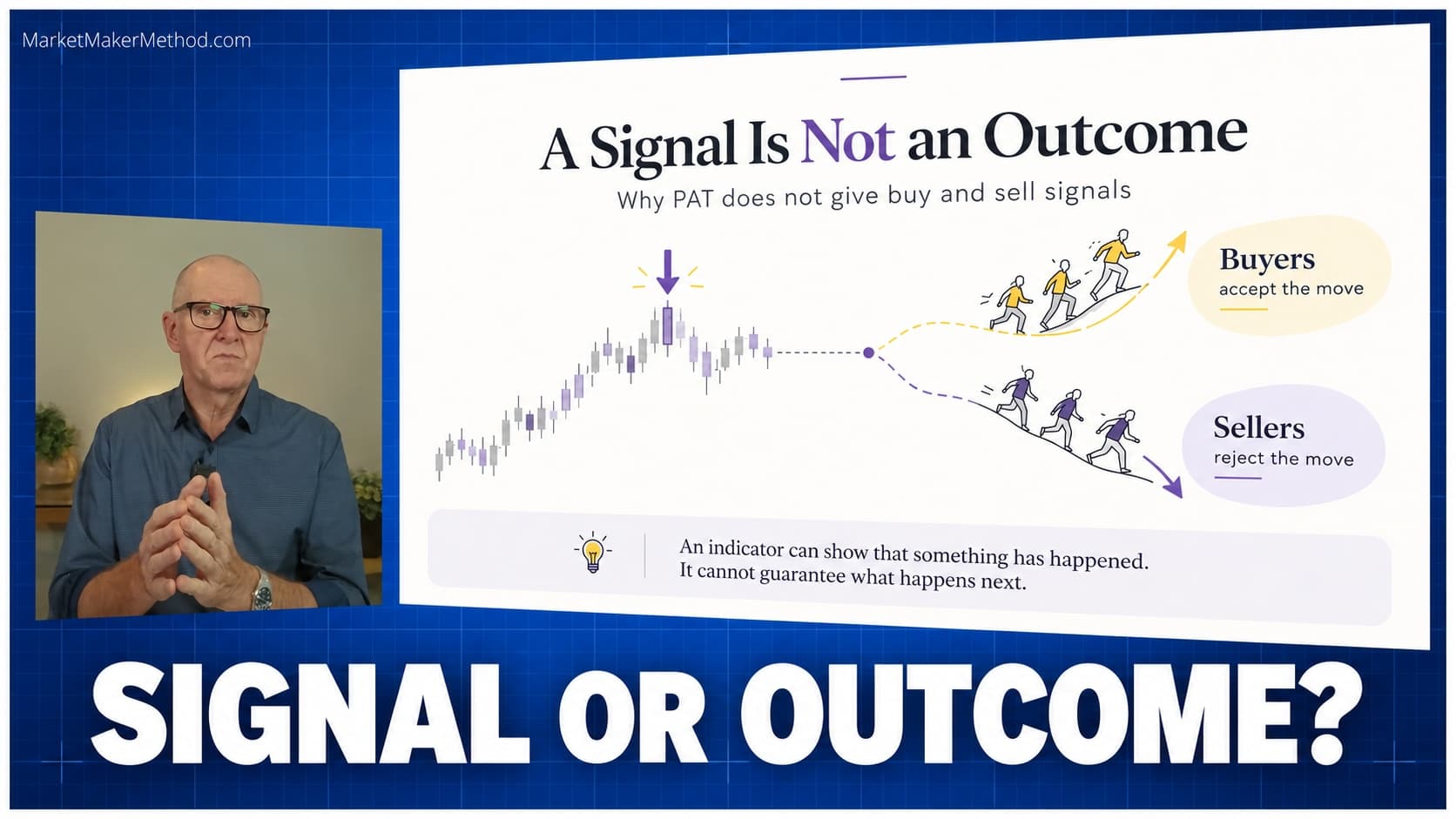
No indicator can promise the next outcome. It can tell us something about what has happened, or what appears to be developing. It cannot guarantee what the next group of buyers or sellers will do after it appears on your chart. If we expect certainty from an indicator, we will eventually be disappointed, and we may blame the indicator when the real problem was the expectation we placed upon it.
What do you actually control as a trader?
That brings us to a much more useful question: what do you actually control? You can choose:
- when you look at the market;
- how many markets you follow;
- how much money you’re prepared to risk;
- to wait;
- to leave when your reasons for being there are no longer there.
Those are real decisions, and they belong to you. What you cannot choose is where the price goes next. The less you demand that kind of control, the more room you have to concentrate on the decisions that really are yours.
Ask what the market is doing now, not where it will go next
For me, this changes the question we ask when we open a chart. Instead of “Tell me where the price is going next,” I want to ask, “What is the market doing now?” Is it building activity? Has it pushed into higher or lower prices? Is that push being accepted, or rejected?
Those are things we can look for as they develop. We don’t need to know the answer in advance. In fact, we should be prepared to change our minds as new information arrives. That isn’t indecision. That’s paying attention.
Here’s a simple example. The market pushes into new territory. There may be a Pressure Point on the chart, or you may simply see price moving away from an area where it had been spending time. The important thing isn’t to say, “There’s an arrow, therefore I must buy or sell.” It’s to ask what happens next. Do buyers continue to support those higher prices, or do sellers come in and push the market back? With a downward push, the same question applies the other way round.
This is why I’ve spent so much time simplifying PAT for TradingView: the Ray Lines, the Purple Dots and the Pressure Points. They are there to draw attention to developing behaviour, not to promise an outcome. And you can practise observing all of it without placing a trade.
An exercise: watch the market without trading
If trading has become uncomfortable, here is something I’d encourage you to try.
- Choose a short period during an active trading session.
- Open one chart. Before you begin, make a very clear decision that you are not going to trade. Not even on a demo account. You’re simply watching.
- When something attracts your attention, describe it in plain language. What happened? What would suggest acceptance? What would suggest rejection? What would make you reconsider your first impression?
- When your time is up, close the chart. No score, no profit target, nothing to recover.
This isn’t a cure for serious anxiety, and you don’t need to force yourself through distress. It’s simply a way to separate observing the market from the pressure to make money.
You might be surprised by what you begin to notice once that pressure is removed. Perhaps you spot something you would previously have chased. Perhaps you recognise that there’s no clear direction, and simply walk away. Perhaps you realise that the reasons for your original view have disappeared. Those are useful observations. You haven’t made a penny, but you’ve practised making sense of a changing situation.
Is doing nothing a valid trading decision?
Doing nothing can be a perfectly good decision. It doesn’t mean you’ve wasted your time. It means you haven’t invented a trade just because you happened to be sitting in front of the screen.
Starting again, without the pressure
If you’ve had years of difficult experiences with trading, I don’t expect one video or one article to make those feelings disappear, and I certainly wouldn’t suggest rushing back into risking money. If your distress is significant, getting help from a qualified professional may be a sensible step.
But I’d like you to consider this. You don’t have to recover yesterday’s losses. You don’t have to prove that all those years of study were worth it. You don’t owe the market anything. You can begin again simply by observing: by asking what is happening, rather than demanding to know what must happen.
Concentrate on the decisions you can control, and accept that the market will make its own. To me, that’s a much healthier place from which to trade.